Articles ·
A Telegram bot for your business: what an honest bot does and where the law draws the line
A customer messages you at 11 pm: how much is it, is there a free slot on Saturday, how do I get there. Your manager replies in the morning — by then the customer has found someone else. A bot answers straight away. But only an honest bot builds trust in your company instead of eroding it.
When you really need a bot
- You get the same questions every day: prices, opening hours, address, terms.
- Customers book or order and you handle it by hand in a messenger.
- Requests get lost in your staff’s personal chats.
If you get a few questions a week, you do not need a bot — an FAQ page on your website is enough.
Four types of bots
- FAQ bot: answers frequent questions and passes requests to a manager.
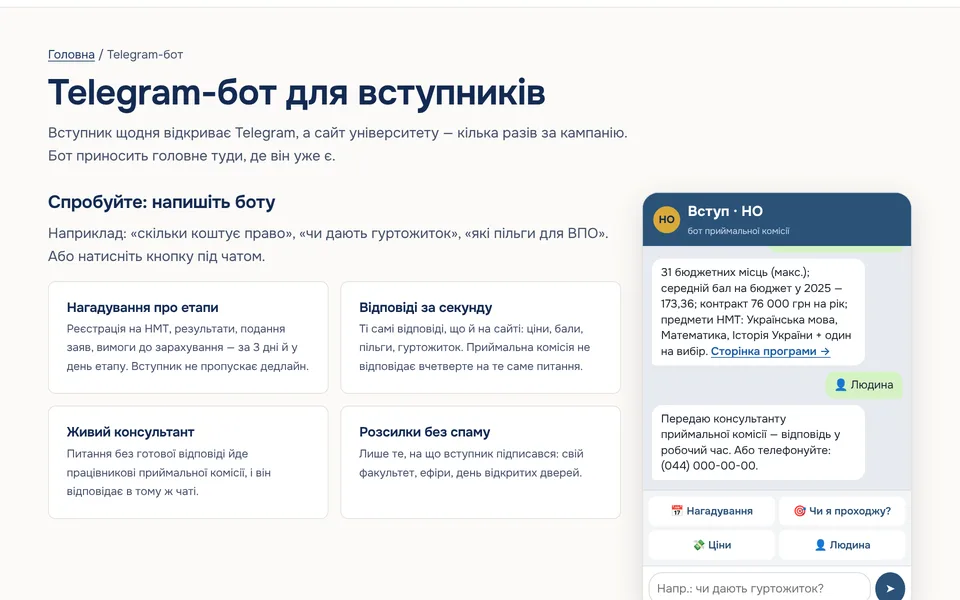
- Bot connected to your website: answers from the same prices and terms as the site. Update the site and the bot knows.
- Sales or booking bot: catalogue, free slots, orders, a spreadsheet or CRM connection.
- Support: someone has to keep the answers up to date, or in six months the bot will quote old prices.
An honest bot: five rules
- It says it is a bot and never pretends to be a person.
- It answers only from what you approved. No answer — it says so and passes the question to a person.
- It tells people when a human will reply: “a manager will answer tomorrow from 9:00”.
- It messages only people who subscribed, with a one-tap unsubscribe.
- It never asks for passport details, ID numbers, health data or card details in the chat. Payments go through a payment provider only.
Where the law draws the line
Even a name and phone number in Telegram are personal data, so in the EU and the UK the bot falls under the GDPR. Collect the minimum, explain in the first message who processes the data and why, and do not keep conversations longer than necessary.
If the bot answers with the help of artificial intelligence, the EU AI Act requires telling people they are talking to an AI system. Health, education, finance and the public sector have their own rules — check them before launch. The bot owner is responsible for its answers, so approve every answer in advance.
Where to start
- List the 10–20 questions you hear most often, with the answers.
- Decide who answers the questions the bot passes on, and when.
- Decide what data the bot really needs. A name and a phone number are usually enough.
- Write the first message: who you are, what the bot can do, what data it processes and why.
OLBO builds honest bots from €390, with a brief right on the Telegram bots page. For universities, see A chat bot for university admissions.