Articles · · Читати українською
How many applications does an AI assistant bring? What the cases in the US and Ukraine show
A chatbot for applicants appears in almost every university presentation. For some universities it really added applications. For others it only added conversations. Here is what the sources say, and what they leave out.
First the experience abroad, then Ukraine.
Abroad
Georgia State University (USA). In 2016 it launched a bot called Pounce for students who were already admitted. It was tested in a controlled trial: half of more than 7,000 admitted students received messages from the bot, the other half did not. The bot’s developer reported that “summer melt” (admitted students who never show up in the autumn) was 21.4% lower. Enrolment rose by 3.3 percentage points according to the researchers (the developer reports 3.9%). These were not new applicants. They were students the university already had but could lose over a missing document or an unpaid deposit. The bot reminded them of deadlines and answered questions at night.
Purdue and Purdue Northwest (USA). According to a case study by the developer AtlasRTX, on the master’s programme pages of the Purdue business school the bot handled 88% of conversations on its own, and 20% of the people who talked to it submitted an application. According to a case study by the developer Gravyty, Purdue Northwest had 9% more accepted students, and 40% of enquiries came outside working hours. These are marketing materials from the vendors themselves, with no independent check and no baseline to compare against. The accepted students in this case might have come without the bot too.
Why this happens. In a study by Tata Consultancy Services (carried out by a company that sells IT services, among 200 university leaders in the UK, the US and Australia), 88% see technology as a driver of innovation, but only 35% consider their university digitally mature. The main obstacles named: budget, outdated systems, resistance to change.
Ukraine
A measured case. One Ukrainian university described in a professional journal a GPT-4 chatbot on its site for applicants. Page visitors rose to 76 a day from 23, time on the page grew from 1.1 to 4.3 minutes, and 58% of visitors used the bot. The authors say honestly that they had no control group, sample size or exact dates. They did not measure the number of applications. So this is evidence of interest, not of admissions.
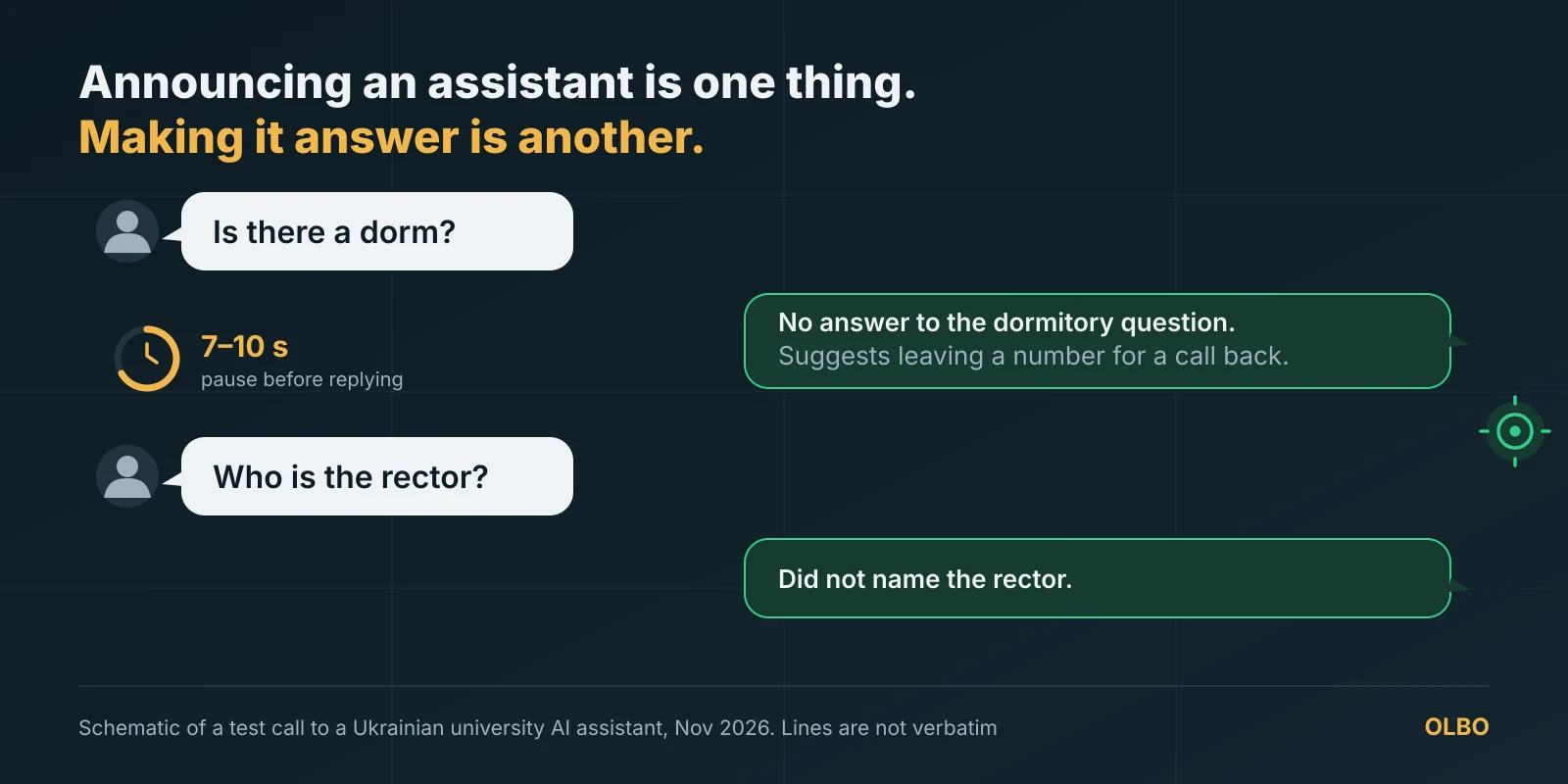
One phone call. Another Ukrainian university announced an AI assistant for its admissions office in July 2025: with a name, in the news, available around the clock. We called its number. The assistant answers by voice, but thinks for 7–10 seconds before every reply. It had no answer to a question about the dormitory and suggested leaving a phone number for a call back. It did not name the rector. It is also hard to find: there is no chat widget on the home page, and the number appears only in the footer of the home page and in the contacts of a separate admissions site.
This is one call, and we do not judge the whole project. But the scenario is familiar: a bot is announced as an event, not maintained as part of the website. An assistant that does not know about the dormitory answers fewer questions than a “Frequently asked questions” page.
Why this happens here. Not because leaders do not care about technology: the study above shows the opposite. On top of budget and old systems comes the habit of relying on one’s own people: “we will do it ourselves”. This is our own observation, not from the study. It is this habit that most often delays such projects for years.
What a good assistant looks like
Successful cases share three things: the bot answers from the same data as the website, it hands over to a person what it does not know, and its result is measured in applications, not in the number of conversations. This is how our assistant works:
- It understands an applicant’s own words: slang, typos, even Latin letters.
- It answers only from data the university has confirmed, and links to the source page.
- If there is no answer, it says so honestly and passes the question to an admissions officer, who joins whenever asked.
- It always says that it is AI, not a person.
- Unanswered questions are collected in the rector’s cabinet: a staff member writes the answer without a programmer, and from that moment both the website and the Telegram bot know it.
- One assistant works both on the website and in Telegram, so the answers do not diverge.
- Structured answers on the website let ChatGPT describe the university from its own data, not from forum rumours.
We also have an AI rector separately: it addresses applicants in the rector’s own voice and likeness in Ukrainian and five more languages, only with the rector’s written consent, and the video always carries the label “Created with AI”.
You can try the assistant on the demo site: demo.olbo.com.ua (the “Є питання?” button, bottom right). Terms and prices: the “Pricing” section.
We can show a demo built on your university’s data in 30–45 minutes. Write to hello@olbo.com.ua or leave a request.
Sources
Georgia State University and Pounce: Campus Technology (2017), eCampus News (2017), Mainstay, BestPractice.ai (summary of the study).
Purdue, AtlasRTX case study. Purdue Northwest, Gravyty case study.
Tata Consultancy Services, reported in Times Higher Education (2026).
Bulletin of the Lviv National University of Environmental Management, article on a GPT-4 chatbot.
A test call to the AI assistant of one Ukrainian university, November 2026 (name withheld).