Articles ·
Hiring for defence companies: why engineers take six months to find and how not to lose candidates
Ukrainian defence companies compete for the same engineers, operators and assemblers, and a hardware engineering job in defence tech gets only 2.5 applications on average. A check of 50 private defence companies’ websites showed that almost half of them (46%) have no careers section of their own, and none of their own job pages shows a salary. Here is where companies lose candidates, how a careers section on the company website helps find engineers faster, and how much it saves.
Why and how we ran the check
The goal is to show defence companies where they lose candidates and to help make hiring more effective. We looked only at public pages that any visitor can see: no logging in, no password guessing, no interference with the websites and no collection of personal data. The list of companies came from public employer pages on DOU, Ukraine’s largest tech job site. Every result was checked by hand. We do not name companies: the aim is to show the picture across the industry, not to point at anyone. Data as of 16 October 2026.
What the check found
- Careers section on the company’s own website54 %
- Only a link to an external hiring service18 %
- No careers section, at most an email address28 %
- Application form right on the site53 %
- Hiring stages or timelines described20 %
- “No reply means no”20 %
- Salary shown0 %
- Promise to reply to every candidate0 %
Salaries on external hiring services (PeopleForce, DOU, etc.) were not checked — only on the companies’ own websites.
The biggest gap is in the two things a candidate looks for first: how much the job pays and whether they will get a reply. The defence companies’ own careers pages offer neither. Only one company out of 50 promises to reply to candidates within a stated time — and its careers page had no open vacancies at the time of the check, so it is not among these 15.
The lack of a reply is exactly what frustrates candidates most. In a public discussion of defence tech hiring on DOU, candidates complain that they get no reply or are turned down without explanation; one writes that in half of cases there was no proper feedback at all. That is why a guaranteed reply to everyone is an advantage for a company: it stands out in the market and earns positive reviews as an employer — even from those it turned down.
What this means for a defence company
Defence tech is one of the hottest job markets in Ukraine. In the third quarter of 2026, 3,942 defence tech vacancies were posted on DOU — a record, about 20% of all vacancies on the site. A vacancy gets 11.3 applications on average, and a hardware engineering vacancy only 2.5 (DOU). Embedded, firmware and RF engineers take 3–6 months or more to hire (DOU, Beetroot Academy).
When a vacancy gets a handful of applications, every candidate counts. An engineer who sees no salary and gets no reply may well be at an interview with another company within a week. For the company, that means more months of searching, more paid job posts and, eventually, a recruitment agency.
What a careers section of your own gives you
- Salary range, region, schedule, reservation from mobilisation and shelter in every vacancy. Benefit: candidates see straight away whether the job suits them, and HR does not spend time on those it does not.
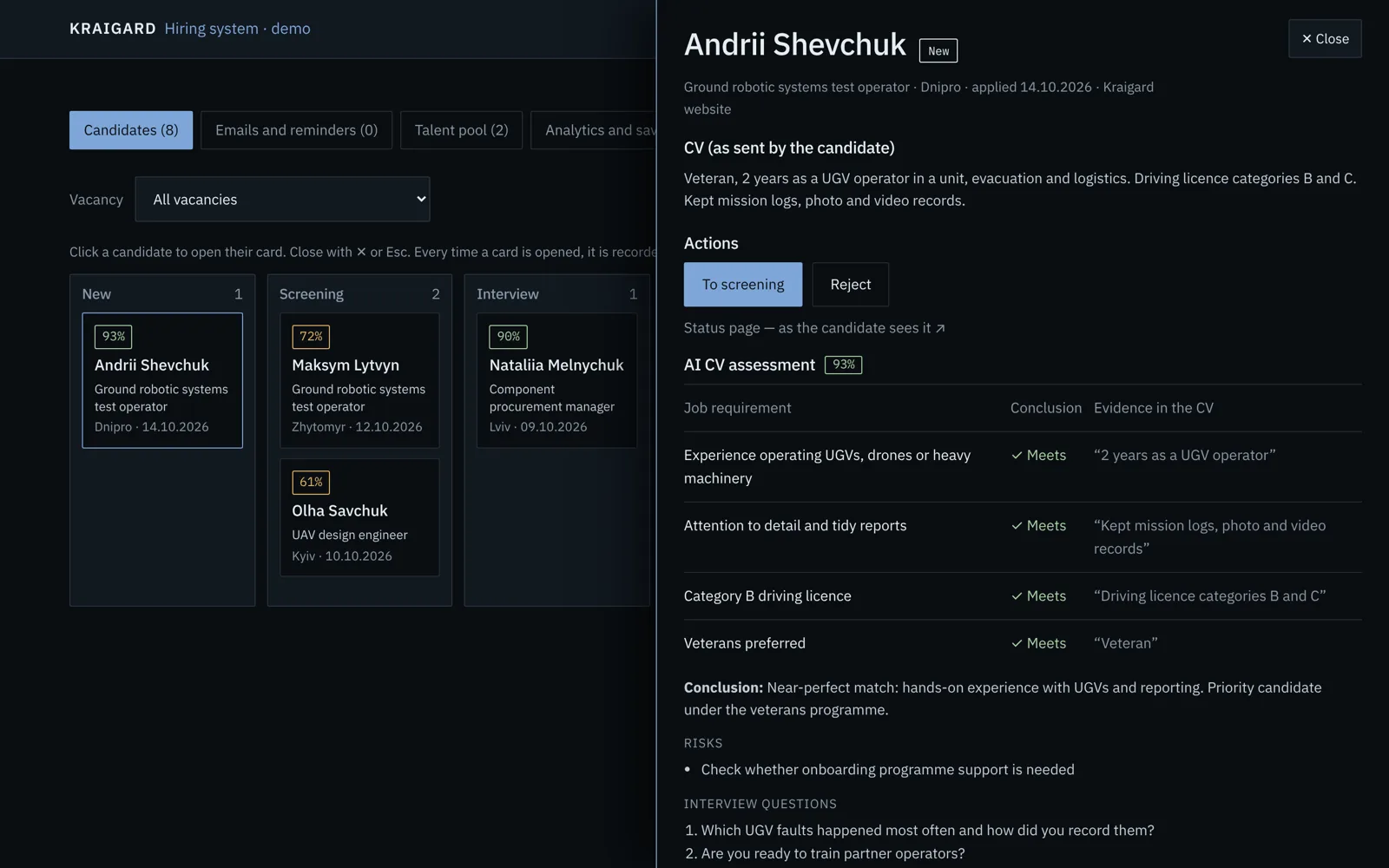
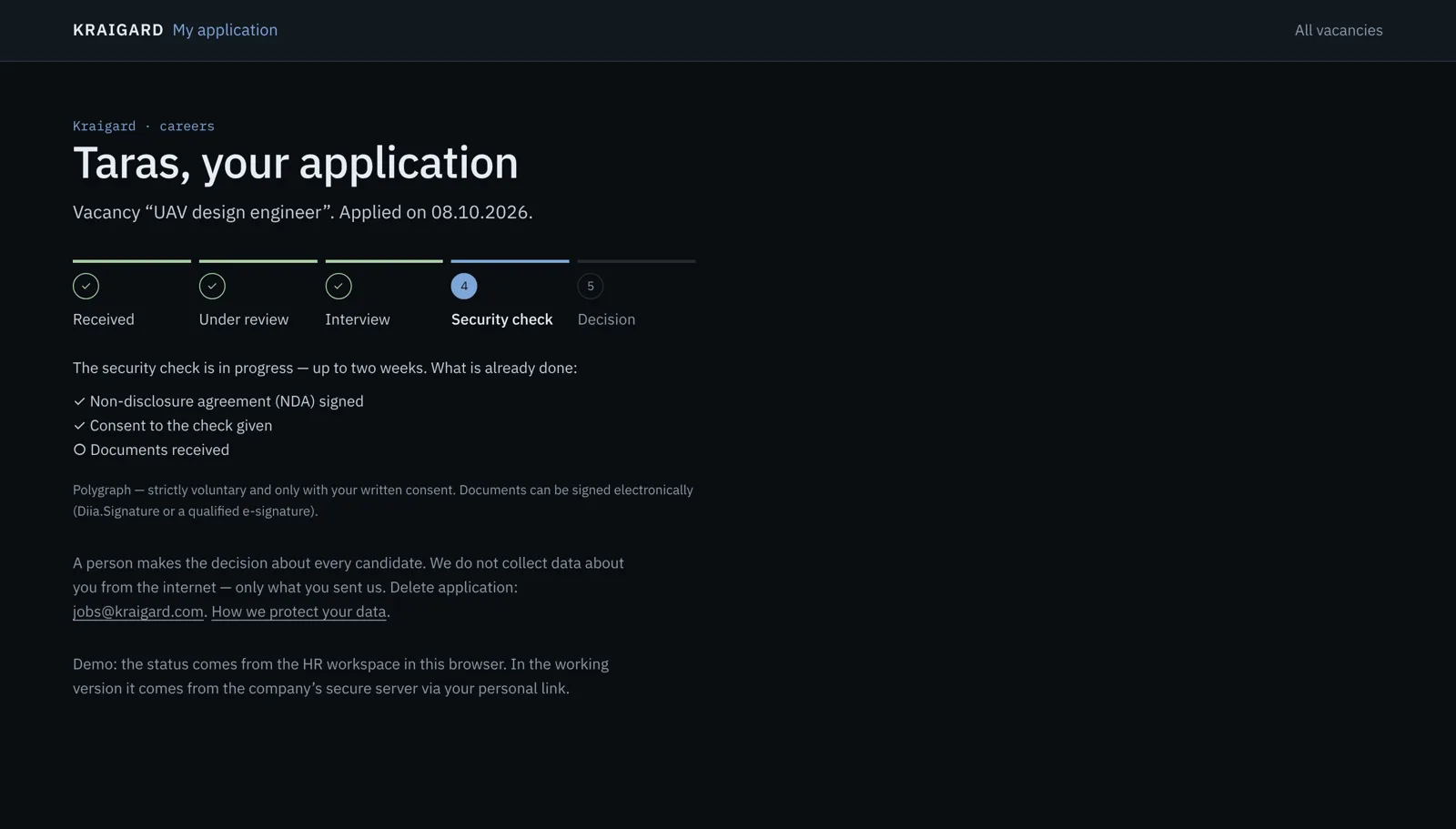
- Every application goes straight into the HR workspace, and the candidate sees the status and the decision date. Benefit: the company does not lose rare engineers to silence.
- A quick application from a phone for production jobs — name, phone and a few buttons, no CV. Benefit: more applications for assemblers and operators.
- Data on the company’s own server, need-to-know roles, an access log and a security team stage with an NDA and consent signed electronically. Benefit: engineers’ CVs do not sit in someone else’s cloud abroad, and the security check becomes part of the process.
- An assistant for the recruiter: AI compares experience with each job requirement and quotes the CV as evidence, while a person makes the decision. Benefit: recruiters spend time talking to candidates, not on routine.
- The company’s own talent pool, with the candidate’s consent. Benefit: a strong candidate stays with the company instead of disappearing into a job site.
Growing an engineer is often faster than finding one
An experienced RF engineer can take months to find, but a defence company can train an assembler, an operator or a junior firmware developer with its own staff in weeks or months. A careers section helps in three ways: vacancies marked “We will train you”; “almost right” candidates from the talent pool; and a training plan built from the gaps the CV assessment revealed.
The company can hire a trainee officially — then the reservation from mobilisation applies during training, provided the salary is not below the set threshold. Benefit: people come to learn and stay, rather than looking for somewhere to get reserved.
When you do not need your own careers section
- The company hires only a few people a year — job sites and email are enough.
- There is already a hiring service with a careers page — it is enough to move it to the company domain and add what is missing: salaries, stages, status for the candidate.
- Do not expect the website to bring candidates by itself: people still come from job sites and referrals. A careers section of your own helps you not lose them after the first click.
How much the company saves
Repeat job posts. From 1 October 2026, a basic vacancy on Work.ua costs UAH 1,090 and a “hot” one UAH 8,990 (Work.ua). A vacancy that stays open for six months is paid for again and again.
Agencies. Their fee is a percentage of the candidate’s salary (The Page). For example, a company fills 40 vacancies a year with an average salary of UAH 45,000. Even at the lowest rate market participants mention — half a monthly salary for each person hired, that is UAH 22,500 — this comes to UAH 900,000 a year.
An in-house recruiter’s time spent on emails, reminders and answering “what is the status of my application?” — instead of finding people.
You do not have to touch the main website
A careers section does not have to be part of the main website. It can live at a separate company address (for example, careers.company-name.com) or on the company’s own server, with just a “Careers” menu item on the main site. This is handy when another studio runs the website or the company does not want to change it.
How it can work
For managers who want to see how such a careers section could work in a defence company, there is a working demo on the website of a fictional company, Kraigard: the careers page and the hiring workspace with HR, department lead and security team roles. You can submit a test application and see what the candidate, HR and the security team see.
We are happy to answer your questions: hello@olbo.com.ua.
Sources: our own check of 50 websites (16.10.2026); DOU, discussion “What is wrong with hiring in defence tech?”, September 2026; DOU, defence tech vacancy analytics, Q3 2026; DOU, Beetroot Academy, July 2026; Work.ua, prices from 1.10.2026; The Page, May 2024.